






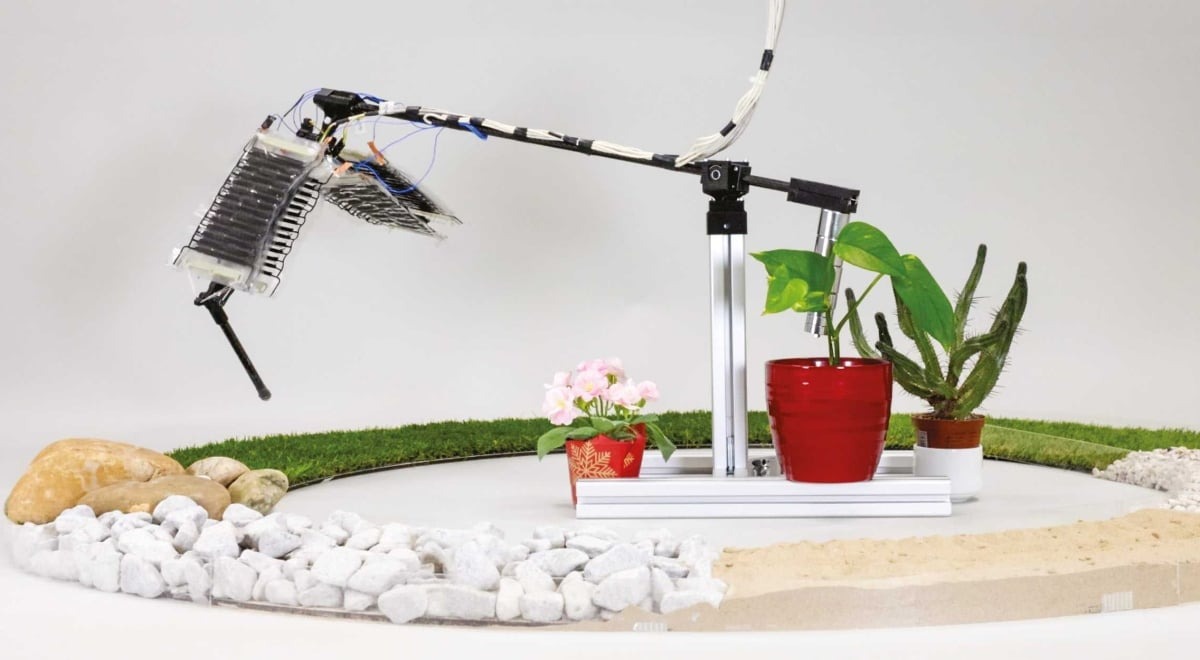
A groundbreaking robotic leg, powered by artificial muscles, has demonstrated remarkable agility in a recent video. Developed by researchers at ETH Zurich and the Max Planck Institute for Intelligent Systems, the leg can effortlessly navigate diverse terrains, including grass, sand, gravel, and even small rocks.
Unlike traditional electric motor-driven robots, this innovative leg utilizes artificial “electro-hydraulic” muscles for propulsion. These muscles not only provide exceptional power but also offer the unique ability to automatically adapt to different surfaces.
The researchers emphasized the system’s superior energy efficiency compared to electric motors, enabling it to perform high jumps and rapid movements without relying on complex sensors. One of the study’s co-first authors, Toshihiko Fukushima, noted that the system eliminates the need for heat management components commonly found in electric motor-driven robots.
Inspired by the mechanics of human legs, the robotic leg incorporates an extensor and a flexor muscle, similar to those found in living creatures. These electro-hydraulic actuators, dubbed HASELs by the researchers, are connected to the leg’s skeleton via tendons.
The actuators are essentially oil-filled plastic bags, resembling those used for making ice cubes. Each bag is coated with conductive electrodes on both sides, allowing them to be electrically charged. As explained by Thomas Buchner, another co-first author, the electrodes are attracted to each other when a voltage is applied, creating a static charge.
This electrostatic force causes the oil within the bag to shift, mimicking the contraction and expansion of a muscle. As one muscle shortens, its counterpart lengthens, enabling the robotic leg to move.
The field of electrohydraulic actuators is relatively new, having emerged only about six years ago. While they may not be suitable for heavy machinery, these actuators offer significant advantages in applications requiring high precision, such as grippers or robot hands.
Robert Katzschmann, who led the study, highlighted the potential of electrohydraulic actuators in soft robotics. Compared to electric motor-driven walking robots, the current system may have limitations, such as being attached to a rod and unable to move freely. However, overcoming these challenges could pave the way for the development of more advanced, fully functional walking robots.
Katzschmann envisions a future where these robotic legs could be integrated into quadruped or humanoid robots, potentially serving as rescue robots or performing other tasks in challenging environments.
The research findings have been published in the journal Nature Communications.